
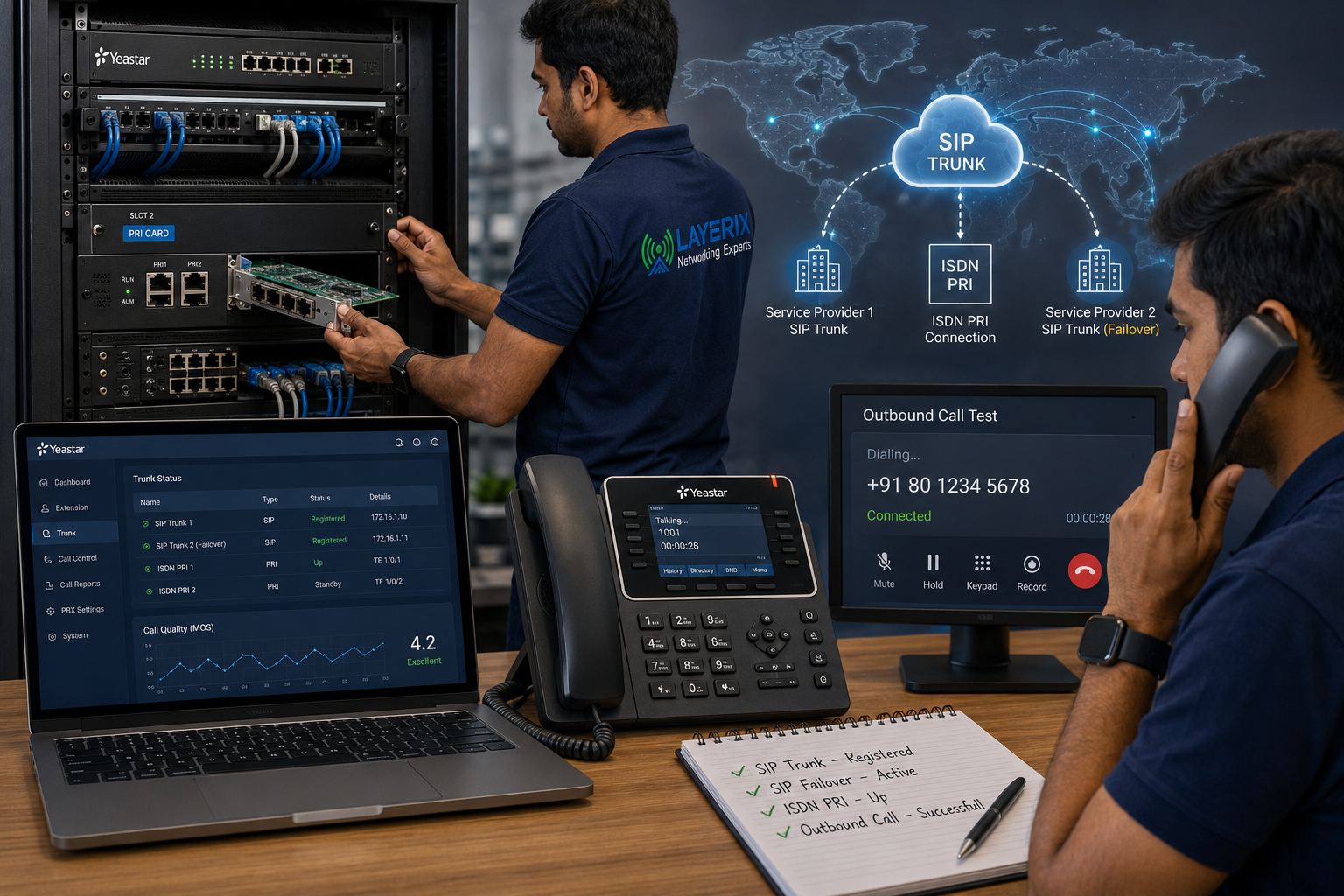
Connect Your PBX to the World
SIP Trunking & ISDN PRI, Done Right.
SIP trunk provisioning and ISDN PRI connections — scalable, cost‑optimised, and configured with failover so your calls never stop.
Trusted by 30+ enterprises across India — reliable PBX connectivity for every call






Why Enterprises Trust Layerix for
Trunk Connectivity
Most trunk setups are left untested. We test failover on every deployment — so your calls continue even when your primary connection drops.

Vendor‑Neutral Provider Selection
We recommend the best SIP trunk provider or PRI setup for your location and call volume — not the one with the best margin.
Failover by Design
Every deployment includes failover testing — we simulate an outage and prove calls keep flowing.
Full Provider Coordination
We handle the entire telecom provider interaction on your behalf — provisioning, number porting, and troubleshooting.
PBX Integration Done Right
Dial plan, DID routing, and call permissions are configured and tested — no guesswork.
100% In‑House Engineers
Your trunking infrastructure is designed and deployed by our 28‑member team — no subcontractors.
Ongoing Support Available
AMC, break‑fix, and managed services to keep your trunks running.
Trunk Deployment Process
Line Audit
Assess existing telephone lines, call volumes, and PBX compatibility.
Provider Selection
Recommend SIP trunk provider or PRI circuit based on cost, location, and features.
Provisioning Coordination
Place orders, manage number porting, and coordinate with telecom providers.
PBX Integration
Configure SIP or PRI settings on your PBX — dial plan, DID routing, outbound rules.
Testing & Failover
Test every inbound and outbound path. Simulate failure to verify failover routes.
Handover & Documentation
Deliver trunk configuration, DID directory, failover procedure, and admin training.
Full Scope of Trunk Deployment
SIP Trunk vs ISDN PRI
| Feature | SIP Trunk | ISDN PRI |
|---|---|---|
| Physical infrastructure | Internet connection | Dedicated copper circuit |
| Cost | Lower — pay per channel | Fixed — 30 channels per PRI |
| Scalability | Add channels instantly | In blocks of 30 |
| Geographic flexibility | Any location with internet | Fixed to circuit location |
| Redundancy | Multiple provider options | Backup circuit required |
| Number portability | Full DID flexibility | Limited to circuit range |
| Hardware required | None beyond PBX | PRI card in PBX |
Layerix recommends SIP trunking for most new deployments. We assess your requirements before recommending.
Real Trunk Deployments
Every photo is from an actual Layerix deployment. No stock imagery. No subcontractors.
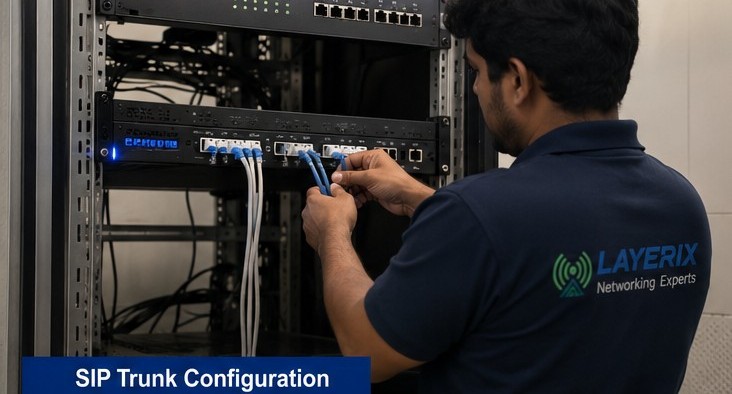
SIP trunk configuration — enterprise client, Bengaluru
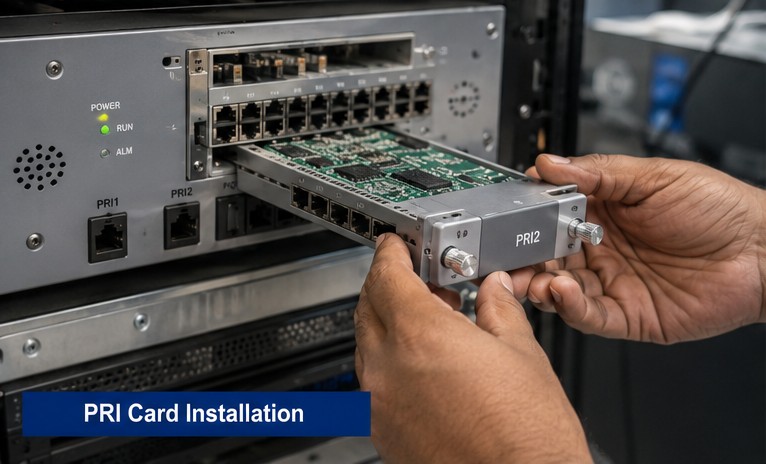
PRI card installation — corporate campus, Chennai
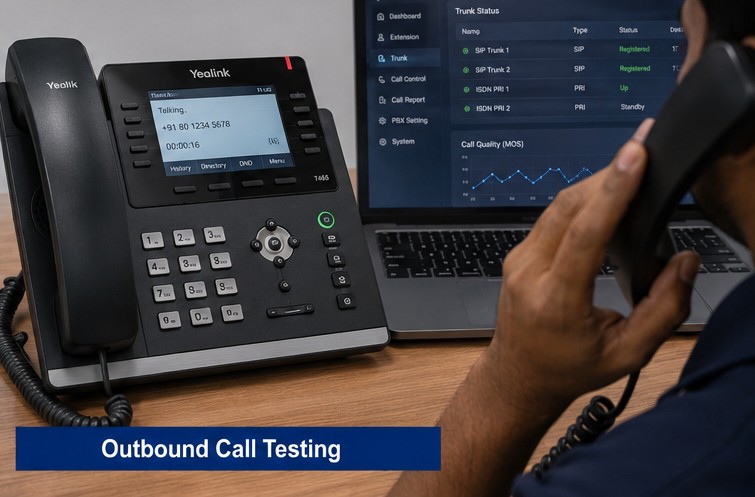
Outbound call testing — logistics hub, Mumbai
50+ Trunk Deployments Across India
SIP trunks and PRI circuits for offices, hospitals, and manufacturing — all 100% in‑house.
Trunk Connectivity for Every Sector
Corporate Offices
Multi‑location SIP trunking
Healthcare
Reliable PRI circuits for hospitals
Hotels & Hospitality
Guest & admin trunk lines
Manufacturing
Factory floor & admin trunks
Pharmaceuticals
Compliance‑ready call routing
Education
Campus‑wide DID management
Banking & Finance
Secure, recorded trunk lines
Commercial Real Estate
Multi‑tenant PBX connectivity
Trunking & SIP Questions
Everything about connecting your PBX to the phone network.
What is a SIP trunk and how is it different from a phone line?+
A SIP trunk is a virtual telephone line delivered over your internet connection using Session Initiation Protocol. A traditional phone line is a physical copper circuit. SIP trunks are lower cost, more scalable (you can add capacity instantly), and support features like DID numbers and simultaneous call paths that are expensive or impossible on analog lines.
What is ISDN PRI and when should we use it instead of SIP?+
ISDN PRI (Primary Rate Interface) is a digital telephone circuit that provides 30 simultaneous call channels over a single connection. It is appropriate when: your PBX is older and does not support SIP natively, your call volume consistently requires 20+ simultaneous calls, or your location has unreliable internet but reliable ISDN infrastructure. For most new deployments, SIP is the better choice.
How many simultaneous calls can a SIP trunk support?+
SIP trunks are typically sold as concurrent call channels — each channel handles one simultaneous call. We size your trunk based on your peak simultaneous call requirement plus 20% headroom. A 50‑person office typically needs 10–20 concurrent channels depending on call volume.
What is a DID number?+
A DID (Direct Inward Dial) number is a telephone number that routes directly to a specific extension or department without going through a receptionist or IVR. For example, your finance manager can have a direct number that rings their extension from outside. DID numbers are allocated as part of your SIP trunk configuration.
Can we port our existing phone numbers to a SIP trunk?+
Yes — number porting transfers your existing telephone numbers to your new SIP trunk provider. The process takes 2–4 weeks depending on your current provider. We coordinate the technical configuration required on the PBX to receive ported numbers.
What happens to calls if our internet connection goes down?+
We configure failover routes for every SIP trunk deployment — typically routing calls to mobile numbers or a secondary SIP trunk on a different ISP if the primary connection fails. We also test failover before handover to confirm it works under real conditions.
Do you work with all SIP trunk providers in India?+
We work with all major SIP trunk providers operating in India. We are not tied to any single provider — we recommend based on your location, call volume, and required features.
Can SIP trunks handle international calls?+
Yes. SIP trunk providers typically offer competitive international rates, and outbound international calling is configured as part of your dial plan. We set up per‑extension or per‑group international call permissions to control cost and prevent misuse.
What is the difference between a SIP trunk and a hosted PBX?+
A SIP trunk connects your on‑premise PBX to the public telephone network. A hosted PBX replaces your on‑premise PBX with a cloud‑based system. Layerix specialises in on‑premise PBX with SIP trunk connectivity — giving you full control of your system without dependency on a cloud service.
How long does SIP trunk provisioning take?+
Provisioning a new SIP trunk typically takes 3–7 business days from order confirmation. Configuration on the PBX takes 1 day. Number porting adds 2–4 weeks. We provide a complete timeline before work begins.
Can we have SIP trunks at multiple office locations?+
Yes — each site can have its own SIP trunk, or a central SIP trunk can be distributed to remote sites over your WAN. We design the trunking architecture based on your site connectivity and call volume per location.
Our Trunk Connectivity Success Stories
Real outcomes from enterprises across India























METEC Design and Construction Engineers India Private Limited
India












Ready to Connect Your PBX to the World?
Book a trunk consultation. We'll analyse your current lines, recommend the best SIP or PRI setup, and deliver a fixed‑price quote — no obligation.
Response within 4 business hours · Pan‑India deployments · All major SIP providers supported